Fibreglass (FRP) rainwater harvesting tanks from 5,000L to 150,000L for commercial buildings, councils, schools, industrial sites and remote projects. Made in Australia by Mullaly.
Mullaly underground rainwater tanks store roof runoff below ground so it can be reused on site. They are built for jobs larger than a house: single tanks run from 5,000L up to 150,000L for some applications, and several tanks can be connected for bigger rainwater harvesting systems.
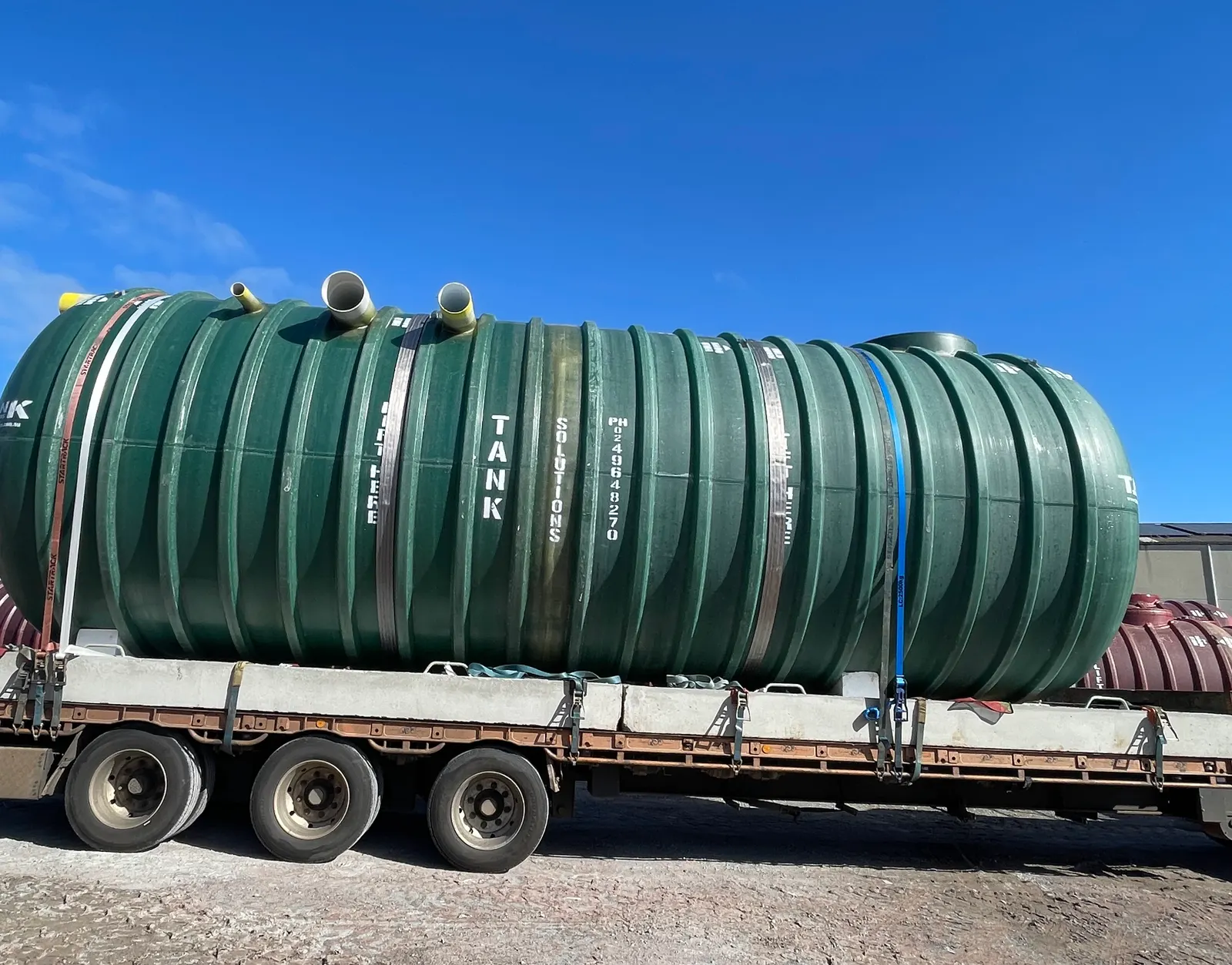
The tanks are fibreglass with integral, high-profile ribs that give them their strength. They are rust and corrosion proof, designed to be 100% watertight, and need no lining, coating or ongoing tank maintenance. Because the tank goes underground, the ground above stays free for landscaping, paths and open space.
The same tank range is used for stormwater retention, fire water storage and potable water, so one supplier can cover more than one tank on a site.
On commercial and industrial sites, rainwater harvesting tanks most often supply non-potable uses:
A harvesting tank can also hold water for fire protection, for sprinkler systems and dry-hydrant connections. See fire water tanks.
If the water will be used for drinking, the tank material matters. Mullaly tanks are certified to AS/NZS 4020 for contact with drinking water. The quality of the water still depends on the roof, the gutters and any treatment, so drinking water systems should be designed with that in mind. See potable water tanks.
A commercial rainwater harvesting system usually has these parts:
The hydraulic engineer or plumber designs the system and sets the pipe sizes and levels. We build the tank to suit, with the access risers, manways, inspection ports, ladders, baffles and connection points the design needs.
Where the tank sits too low for water to drain out by gravity, a stormwater pump station can empty it. These are made in one piece from the same fibreglass as our tanks.
| Item | Detail |
|---|---|
| Single tank capacity | 5,000L to 150,000L (the largest sizes for some applications) |
| Larger volumes | Several tanks connected with PVC or fibreglass pipework |
| Diameter | Up to 3.28m |
| Wall | Single wall or double wall |
| Installation | Underground, and select above-ground installations |
| Structure | Integral, high-profile fibreglass ribs, designed for the soil and surface loads on each site. Not limited by the water table |
| Material | Fibreglass (FRP) with resin that contains no fillers. No protective lining or coating needed |
| Drinking water contact | Certified to AS/NZS 4020 |
| Accessories | Access risers, manways, inspection ports, FRP inspection ladders, baffles, and inlet, outlet, overflow and vent points |
Full details are in the water storage tank technical data sheet (TD_TDS_003). For tanks of 20,000L and over, see our large water tanks page.
Tank size comes from three things: how much roof drains to the tank, how much rain falls there, and how much water the site uses each day. As a rule of thumb, 1mm of rain on 1m² of roof gives about 1L of water, less what is lost to evaporation, splash and first-flush diversion. A 2,000m² roof in a 10mm storm can collect close to 20,000L.
A bigger tank captures more of each storm but costs more and takes more room. The designer balances the two against demand, often with a rainfall model for the site. Some councils also require new developments to capture and reuse part of their roof runoff, so check the local development control plan before sizing.
Council and engineering figures are often given in cubic metres. One cubic metre is 1,000L, so a 45m³ requirement is a 45,000L tank. Send us the volume from the design and we will recommend one tank or a set of connected tanks.
The tank sits below ground, so it takes no floor or yard space and the area above can be landscaped.
Integral fibreglass ribs give the tank its strength, and the ribs are designed for the soil and surface loads on each site.
Designed to be 100% watertight, so harvested water stays in and groundwater stays out.
Fibreglass resists the surrounding soil and the stored water, with no lining or coating to wear or repair.
The tank structure needs no ongoing maintenance or inspections. Screens, first-flush devices and pumps still need routine checks.
A large-capacity tank ships on one truck bed and can be installed in remote places and tight footprints.
Each tank is supplied with Mullaly's installation manual. Fibreglass tanks are light for their size, so a large-capacity tank ships on one truck bed and can go into a tight site between buildings or boundaries, or to a remote location.
Because the tank is not limited by the water table, it suits sites with high groundwater. Tell us the groundwater level and what will be above the tank when you ask for a quote. If you are comparing materials, see fibreglass vs concrete water tanks.
For tanks used for wash-down, emergency storage and other site water, see our industrial water tanks and underground water tanks.


Single tanks run from 5,000L to 150,000L for some applications, in diameters up to 3.28m, single or double wall. Larger volumes are made up of several tanks connected with PVC or fibreglass pipework.
A rainwater tank usually collects roof water only, which is cleaner. A stormwater retention tank also takes runoff from paved and ground surfaces, which carries more sediment and needs more treatment before reuse. Both keep the water on site for reuse.
Mullaly tanks are certified to AS/NZS 4020 for contact with drinking water. The safety of the water also depends on the roof, the gutters and the treatment, so a drinking water system needs to be designed for it.
Yes. Mullaly tanks are not limited by the water table. Their integral fibreglass ribs are designed for the soil and surface loads on each site. Tell us the groundwater level when you ask for a quote.
Yes, a pump is needed to deliver the water to the building. Where the tank also has to be pumped out to the drainage system, a Mullaly stormwater pump station can do that job.
The tank structure needs no ongoing maintenance or inspections. Leaf screens, first-flush devices and pumps should be checked and cleaned on a regular schedule.
More documents are in the resource centre.
Enter your email and the brochure opens straight away. We will also email you the link.
Send us the storage volume, the roof area, the site address and the groundwater level if you know it. We reply to every enquiry within 2 business days.
Or call 02 4964 8270 or email sales@mullaly.com.au