Skip to content

Concrete and fibreglass water tanks

Concrete water tanks are the familiar choice for underground storage, and many buyers price one first. An underground concrete water tank is built in one of two ways:

  • Precast concrete. Made in a precast yard, either as one unit or in sections that are joined and sealed in the excavation.
  • Poured in place. Formwork and reinforcing steel are set up in the excavation, the concrete is poured, and the tank is left to cure before it is finished and tested.

A fibreglass (FRP) tank is made in one piece in a factory and lifted into the hole complete. Mullaly makes underground fibreglass water tanks from 5,000L up to 150,000L for some applications, single or double wall, at our factory in Tomago, NSW. This page sets out how the two compare, including where concrete is the better choice.

Fibreglass and concrete water tanks side by side

FeatureMullaly fibreglass (FRP) tankConcrete tank
How it is madeIn one piece in a factory, with integral, high-profile fibreglass ribs for strengthPrecast as one unit or in sections joined on site, or poured in place
Size rangeSingle tanks 5,000L to 150,000L (the largest sizes for some applications), diameters up to 3.28m. Larger volumes from several tanks connected with PVC or fibreglass pipeworkPrecast sizes vary by maker. Poured tanks can be built to large, custom sizes
WatertightnessDesigned to be 100% watertight, with no joints to seal on siteDepends on the quality of joints, seals and concrete placement. Cracks and joints are where leaks start
CorrosionRust and corrosion proof. Resists the surrounding soil and the stored liquid. No lining or coating neededDurable with clean water. Reinforcing steel can corrode where cracks let water in, and wastewater needs a lining or coating
Weight and handlingLight for its size. A large-capacity tank can ship on one truck bedHeavy. Large units need heavy transport and a large crane
High groundwaterNot limited by the water table. Installed and held down to the Mullaly installation manualThe tank's own mass helps resist uplift
Surface loadsRibs designed for the soil and surface loads on each siteCan be designed for heavy surface and traffic loads
MaintenanceNo ongoing maintenance or inspections required for the tank structureWorth inspecting over its life for cracks and joint leaks
Remote and tight sitesEasy to ship to remote places and install in tight footprintsNeeds a precast yard within reach, or a concrete supply for a poured tank
Local supplyMade in Tomago, NSW and trucked to sitePrecast yards in most regions, so haulage can be short

Concrete tanks vary by maker and design. Compare the specific tanks you are quoted, and check the installed cost, not just the price of the tank.

Installation time and access

The tank is only part of the cost. Excavation, shoring, dewatering, crane hire and weather delays all grow the longer a hole is open. A poured concrete tank keeps the excavation open while it is formed, poured and cured. A precast tank goes in faster, but heavy units need a large crane and room for it, and sectional tanks still need their joints sealed in the hole.

A fibreglass tank arrives complete and goes in with a smaller lift. Our fibreglass pump stations come out of the same factory and show what a one-piece unit does on site. At the Sydney Airport waste dump, a combo pump station went from crane hook to levelled and ready for backfill in under one hour. At the Sino Iron Red River village in the Pilbara, two fitted-out combo pump stations were installed in under a week, compared with more than six weeks for in-situ concrete.

For storage, at Sydney Airport Pier B we supplied two 85kL overflow storage tanks with the pump station. The whole system arrived on three semi-trailers and was lifted into place once excavation was complete.
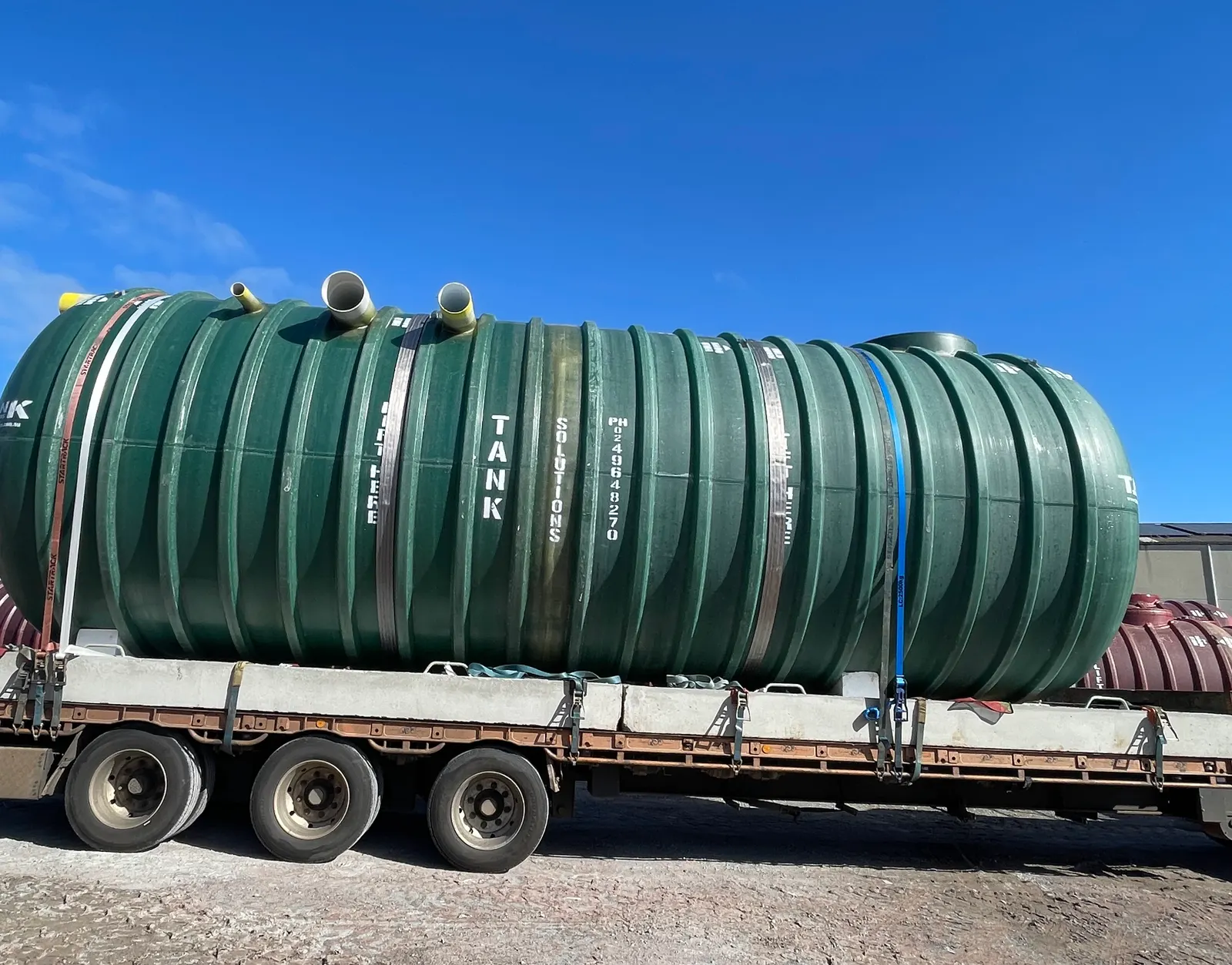
Large ribbed fibreglass water storage tank strapped to a trailer for delivery to Norlane, Victoria

Watertightness and corrosion

A one-piece fibreglass tank has no joints between sections and does not rely on sealants applied on site. Mullaly tanks are designed to be 100% watertight, so stored water stays in and groundwater stays out. That matters for stormwater retention tanks and rainwater tanks, where groundwater getting in takes up storage, and for wastewater storage tanks, where nothing may leak out.

Concrete holds clean water well when it is well made, and many concrete water tanks give long service. The weak points are the joints in sectional tanks and any cracks, which can let water in or out and expose the reinforcing steel. In wastewater the problem is bigger: hydrogen sulphide (H2S) gas forms sulphuric acid, which corrodes steel in concrete, so concrete wastewater tanks need an internal coating or liner. Mullaly tanks use resin with no fillers and need no protective lining or coating, and they resist both the surrounding soil and the stored liquid.

When a concrete tank is the better choice

Concrete is the right answer on some jobs:

  • Very large single volumes. A poured tank can be built to a size and shape that suits the site. Above 150,000L, Mullaly volumes are made up of several tanks connected together, which suits some sites and not others.
  • Heavy traffic above. Where the engineer needs a tank designed for heavy vehicle loads, concrete is a common choice. Tell us the surface loads and we will tell you what our tanks are designed for on your site.
  • A precast yard nearby and good crane access. Short haulage and an open site take away much of the weight problem.
  • The specification calls for it. Some asset owners and engineers specify concrete.

A fibreglass tank is worth pricing alongside concrete where the site is remote or tight, the groundwater is high, the hole should be open for as short a time as possible, or the stored water is corrosive.

Comparing the cost

The purchase price of a concrete tank can look lower, especially from a nearby precast yard. Compare the installed cost instead:

  • Transport to site, and how many truck movements it takes
  • Crane size and hire time
  • How long the excavation stays open, with shoring and dewatering
  • Sealing and testing joints on site
  • Linings or coatings, and their upkeep, for wastewater
  • Inspections and repairs over the tank's life

Send us the volume, the site conditions and how the water will be used, and we will quote a Mullaly fibreglass tank to compare with your concrete price.

What Mullaly fibreglass tanks are used for

Mullaly underground tanks hold water and wastewater for councils, utilities, commercial and industrial sites, and remote projects, including:

For the biggest single tanks, see large water tanks. For more on the material, see why fibreglass (FRP).

Mullaly FRP emergency storage tank on site at North Queensland Stadium, Townsville

Fibreglass and concrete water tank questions

Is a fibreglass water tank as strong as a concrete one?

A Mullaly tank gets its strength from integral, high-profile fibreglass ribs that are part of the tank wall. The ribs are designed for the soil and surface loads on each site, and the tanks are not limited by the water table. Tell us about the site and any surface loads when you ask for a quote.

How big can a fibreglass underground water tank be?

Mullaly single tanks run from 5,000L up to 150,000L for some applications, in diameters up to 3.28m. Larger volumes are made up of several tanks connected with PVC or fibreglass pipework.

Do concrete water tanks leak?

A well-made concrete tank can stay watertight for a long time. Leaks, when they happen, usually start at the joints in sectional tanks or at cracks. A Mullaly fibreglass tank is made in one piece and designed to be 100% watertight.

Will a fibreglass tank float in high groundwater?

Any empty underground tank is buoyant in groundwater, and a heavy concrete tank resists uplift partly by its own mass. Mullaly tanks are not limited by the water table and are installed and held down to the installation manual supplied with each tank. Tell us the groundwater level when you ask for a quote.

Is a fibreglass tank cheaper than concrete?

It depends on the site. A concrete tank from a nearby precast yard can cost less to buy. A fibreglass tank can cost less to install where transport is long, access is tight, the groundwater is high or the excavation needs to be open for a short time. Compare the installed cost.

Can a fibreglass tank hold wastewater?

Yes. Mullaly fibreglass resists the stored liquid as well as the surrounding soil, with no lining or coating, and Mullaly FRP emergency storage tanks are covered by WSAA product appraisal PA 1020 (Issue 4, current to 2031).

Download the water storage tank brochure

Enter your email and the brochure opens straight away. We will also email you the link.

Price a fibreglass tank against concrete

Send us the volume, site conditions and how the water will be used, and we will quote a Mullaly fibreglass tank for comparison. We reply to every enquiry within 2 business days.

Or call 02 4964 8270 or email sales@mullaly.com.au