Skip to content

Three ways to build a pump station

A sewage or stormwater pump station is built in one of three ways:

  • Poured in-situ concrete. Formed and poured in the excavation, then fitted out once the concrete has cured.
  • Precast concrete. Made in sections off site, then lifted in and joined in the excavation, with the joints sealed on site and the fit-out done inside the chamber.
  • One-piece fibreglass (FRP). Made in one piece in a factory, fitted out with pipework and valves, and lifted in as a single unit.

Each can meet a design. The differences are in how long installation takes, how the structure handles sewer gases, how watertight it stays, and how much work has to be done inside a confined space. Mullaly has made one-piece fibreglass pump stations for over 30 years, and the comparison below is drawn from our published product information and project records.

FRP and concrete pump stations side by side

FeatureMullaly fibreglass pump stationConcrete pump station
PackageDelivered as one complete unit, often a combo with an integral valve pit. No assembly on siteComes in sections joined on site, or is poured on site. Fit-out needs access to a confined space
OH&SNo fit-out on site, so little need to enter the station as a confined spaceLong assembly and heavy handling. Fit-out often in confined spaces
TimeCan be installed in a few hours on some projects, which cuts the chance of wet weather affecting the jobLonger assembly. An in situ concrete station typically takes weeks to install, for example over six weeks on Sino Iron and Badu Island
WeightLight weight reduces OH&S risk and makes installation easierHeavy handling increases OH&S risk and makes installation harder
CorrosionVinyl ester resin resists the corrosive chemicals in sewage. No coating or linerSteel in concrete corrodes from H2S gas and the sulphuric acid it produces. Needs an internal coating or liner
Ground movementEngineered to allow for ground movement with no structural fatigueGround movement can crack the concrete and break seals between sections
Life expectancy100-year design lifeCan be designed for 100 years, but often needs repair or refurbishment after early corrosion or erosion
Warranty30-year limited product warrantyVaries
MaintenanceSmooth internal walls stay cleaner for longerRough walls need more frequent cleaning (without an internal liner)
WatertightOne sealed, single-unit construction that does not rely on sealants applied on siteCan leak through cracks, joins between sections or poorly placed concrete
Remote locationsInstalled in some of the most remote places in AustraliaRemote sites often have no concrete supply, and moving heavy units long distances is difficult and costly
Quality controlMade in controlled factory conditions to a design by a registered practising composite engineerQuality of concrete placement varies with the experience of the crew

Corrosion: the main difference

In a sewer, bacteria produce hydrogen sulphide (H2S) gas. Above the waterline it forms sulphuric acid, which attacks concrete and corrodes the reinforcing steel inside it. A concrete wet well therefore needs an internal coating or liner, and that coating has to be inspected and maintained.

Mullaly pump stations are made with vinyl ester resin, which resists the corrosive chemicals in sewage, so no coating or liner is needed. At Ramingining in the Northern Territory, a Mullaly pump station inspected more than 20 years after installation had smooth, clean surfaces and stainless steel fittings in near perfect condition. Read the Ramingining project.
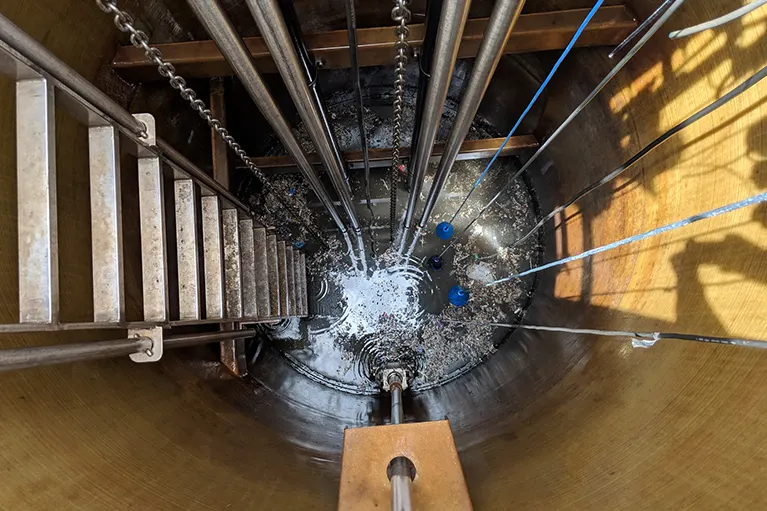
Inside the Ramingining FRP pump station after more than 20 years in service, with stainless steel guide rails and pipework

Installation time and cost

The purchase price of the structure is only part of the cost. Excavation time, dewatering, crane hire, shoring, confined space work and weather delays add up, and they grow the longer the hole is open.

  • At the Sino Iron Red River village in the Pilbara, two fitted-out FRP combo stations were installed in under a week, compared with more than six weeks for in-situ concrete, with less labour and less crane time.
  • At the Sydney Airport waste dump, on reclaimed land with constant wet hole conditions, the station went from crane hook to levelled and ready for backfill in under an hour, which cut dewatering and crane costs.
  • At Innes Estate in Townsville, in sand next to a creek, the FRP wet well and valve pit needed less excavation and shoring, and sand could be used as backfill.
Two Mullaly FRP wet well and valve pit combos on a truck bound for the Sino Iron Red River accommodation village, WA

When concrete may still suit

Concrete remains the usual choice for stations bigger than a factory-made unit can be, and where the asset owner specifies it. The Mullaly WSAA appraisal covers external diameters from 1.2m to 4m and depths to 14m, and larger units are engineered to project, so for very large stations check with us early. For most network, subdivision and commercial sewage pump stations within that range, a one-piece fibreglass station is worth pricing alongside concrete on the whole installed cost.

FRP and concrete pump station questions

Is a fibreglass pump station as strong as concrete?

A Mullaly pump station is designed by a registered practising composite engineer for the internal and external loads on its site, including ground, groundwater and surface loads. Any load on the roof is taken by a reinforced concrete slab spanning the station.

Does a fibreglass pump station float?

An empty wet well in groundwater is buoyant whatever it is made of. Mullaly supplies ballast calculations to counter hydrostatic uplift with the installation instructions.

What is a precast pump station?

A concrete pump station made in sections off site, then joined and sealed in the excavation and fitted out on site.

How long does a fibreglass pump station last?

Mullaly pump stations have a 100-year design life and a 30-year limited product warranty. There have been hundreds of installations and no known structural failures in over 30 years.

Related pages

More on the material on our why fibreglass page. For the design side, see our pump station design guide. For products, see sewage pump stations, wet wells and valve pits.

Download the pump station brochure

Enter your email and the brochure opens straight away. We will also email you the link.

Price a fibreglass pump station

Send us your specification or drawings and we will quote a Mullaly FRP pump station for comparison. We reply to every enquiry within 2 business days.

Or call 02 4964 8270 or email sales@mullaly.com.au

Newsletter